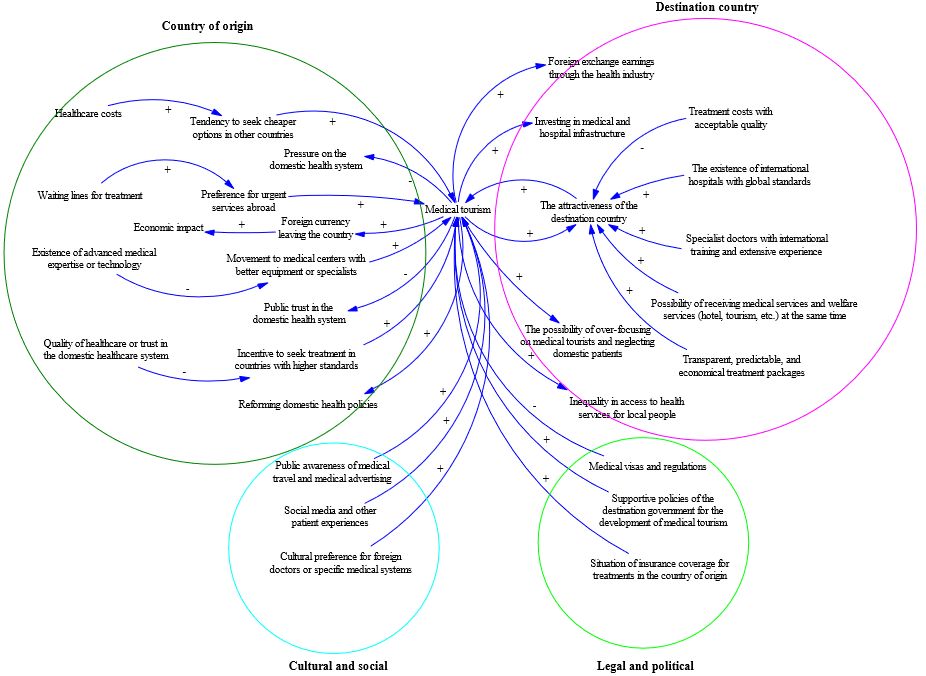
Cause and Effect Relationships Between Healthcare and Medical Tourism
With a System Dynamics Approach
Authors: Farhad Bolouri, Hüseyin Gökçekuş, Ahmet Savaşan, Youssef Kassem, Şeyma Elif Şimşek, and Sinem Becan
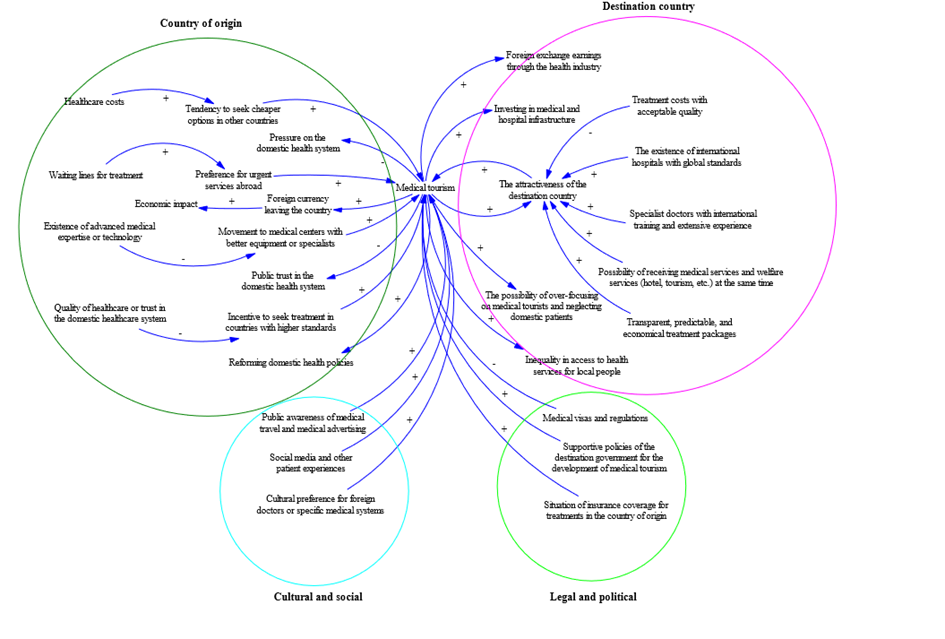
Abstract: Medical tourism, a growing sub-sector of health tourism, involves individuals traveling abroad to receive medical care that is often more affordable, timely, or advanced than in their home country. Unlike traditional medical travel, where ser-vices are unavailable domestically, medical tourism is driven by preferences relat-ed to cost, quality, or waiting time. This study applies a systems thinking ap-proach—specifically, system dynamics modeling—to analyze the complex inter-play of factors influencing medical tourism. Systems thinking provides a holistic perspective by examining how components interact within a system and how these interactions produce observable patterns over time. Using causal loop dia-grams, the study identifies key drivers from both origin and destination countries, including cost disparities, service quality, waiting times, and healthcare infrastruc-ture. The model also considers socio-cultural, legal, and political influences such as public awareness, international accreditation, and visa policies.
DOI: 10.4018/979-8-3373-3131-7.ch015
Biographies:
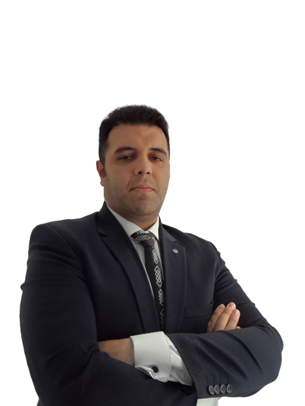
Assist. Prof. Dr. Farhad Bolouri
Assist. Prof. Dr. Farhad Bolouri was born in 1996 in Tabriz. He successfully defended his PhD in Civil Engineering at Near East University in the TRNC. In 2022, he was selected as one of 22 Fellows among 4955 candidates in the Anant Fellowship for Climate Action at Anant National University (India). In 2021, he was awarded the first position in the ideation event held by the Environmental Protection Organization and UNEP for the implementation of innovative projects on national responsibility to tackle climate change with the approach of solutions based on indigenous nature and knowledge. In 2022, he was invited to the SDSN Youth program – Local Pathway Fellowship, as one of 100 young people from all over the world, to implement his idea of air pollution reduction in his city in a 10-month program. Farhad is an Ambassador for the International Ocean-Climate School and Climate Interactive En-ROADS. He was at the Stockholm +50 conference at the invitation of the United Nations and representatives of AlphaZULU Advocates. His areas of research interest include sustainable development, green campus and green management, systems thinking and systems dynamics, climate change, water resource management, and air pollution. He has published several papers on sustainable development and has conducted workshops on water resources management, climate change and simulation, sustainable development, and clean air. Farhad has completed an MSc in Environmental Engineering from the University of Tabriz, and a BSc in Civil Engineering from Azarbaijan Shahid Madani University.
About the Contributors
Hüseyin Gökçekuş
In 1982, Prof. Dr. Hüseyin Gökçekuş received his degree in Geological Engineering Department at Ankara University. Then, in 1984 he commenced his M.Sc. degree at Middle East Technical University. From 1983 to 1990, he was a research assistant in the Geological Engineering Department at METU. In 1990, he received his Ph.D. degree in Geological Engineering Department. In 1992 and 1994, he was promoted to the rank of assistant professor and associate professor, respectively, and to the rank of professor in 2001. His research interests include renewable energy, environment, groundwater, rainfall- runoff modeling, and artificial intelligence applications to hydro- environmental engineering, hydro informatics, and computational hydraulics.
Ahmet Savaşan
Is one of the leading names in the tourism sector in Turkish Republic of Northern Cyprus. He is currently a member of the National Assembly and the 2023- 2024 term president of Global Healthcare Travel Council.
Youssef Kassem
Received his B.Sc. and M.S. degrees in Mechanical Engineering from Near East University, Cyprus in 2009 and 20011, respectively. He then continued his graduate studies in mechanical engineering in the field of thermo- fluid at Near East University, Cyprus, and graduated in 2017. Dr. Kassem was with the Faculty of Engineering, Near East University, as an assistant professor from 2018- 2019 and an associate professor from 2020- present. His research interests include renewable energy, climate energy, sustainable development, and artificial intelligence applications for mechanical and environmental engineering